Category: Neighbourhood Focus

  • Up-and-coming neighbourhoods in Evere: the affordable eastern municipality on the move

    Up-and-coming neighbourhoods in Evere: the affordable eastern municipality on the move

    Long perceived as a discreet municipality, Evere now ranks among the most affordable in eastern Brussels, while concentrating real development dynamics. It is one of the municipalities that attracts young buyers and households in the 36-to-40 age bracket for house purchases. Between a major city-entrance project, a neighbourhood contract and office conversions, here is a factual reading of what is driving the municipality forward.

    A methodological precaution: identifying a sector in transformation never guarantees capital gains, and large-scale projects can experience delays. For context, the median Evere apartment stands at around 240,000 euros, among the most affordable in the Region, below the regional median of 265,000 euros (Federation of Notaries, 2025).

    Bordet and the Bordet-Defence hub

    In the north of the municipality, the Bordet sector is set to undergo the most structural transformation. The so-called Defence site and the economic zones between Bordet station and Evere are identified as a regional development hub: they are to evolve into new urban neighbourhoods, with new housing forms, contemporary offices and a rethought city entrance along Avenue Leopold III and Chaussee de Haecht, supported by improved green corridors.

    The accessibility of these future neighbourhoods would rely on surface-level mobility: extension of the cycle network, extension of tram line 62 and a future airport tram. An important point of attention here: metro 3, whose Bordet station was to be the northern terminus, saw its extension phase suspended by the regional agreement of February 2026. The future service of the sector would therefore rely on tram rather than metro. This is a medium to long-term project, to be followed step by step.

    Upper Evere

    The Upper Evere neighbourhood has concentrated numerous recent residential projects in recent years, and this is where apartment prices are highest in the municipality. The surroundings of Avenue de l’Optimisme and Boulevard Leopold III are among the sectors where houses appreciate best. For anyone looking for new or recent housing in Evere, this is a sector to watch closely.

    Evere Centre and the neighbourhood contract

    The centre of the municipality, around Avenues Conscience and Notre-Dame, is the subject of a sustainable neighbourhood contract concluded with the Region. This urban revitalisation tool finances, over a defined period, projects to improve housing, public spaces, mobility and social cohesion, in consultation with residents. This type of programme durably improves the living environment and supports the attractiveness of the sector concerned.

    Office-to-housing conversions

    As in several neighbouring municipalities, Evere is experiencing a trend towards converting former office buildings into housing. On Avenue Jules Bordet, a former office building has been transformed into a complex of approximately 80 family dwellings, from studios to three-bedroom apartments, with productive spaces on the lower floors. These operations renew the housing stock and add recent properties where they are rare.

    Proximity to major regional projects

    Evere also benefits, at its borders, from two of the largest urban projects in the Region. The Josaphat wasteland, the future sustainable neighbourhood developed on the former marshalling yard, extends on the border between Schaerbeek and Evere. Further west, the Mediapark project, on the Reyers site, plans a new mixed neighbourhood around a large public park. These two projects, detailed in our article on up-and-coming neighbourhoods in Schaerbeek, could eventually strengthen the attractiveness of the Evere surroundings.

    What this means if you are buying or selling

    If you are buying, Evere offers one of the most reasonable entry prices in eastern Brussels, in a municipality where several projects are improving the living environment. Remain cautious about the timeline of large projects such as Bordet, and do not bet on the arrival of a metro whose extension is now suspended. If you are selling, the municipality’s dynamic and accessibility are arguments, provided you remain factual and rely on a valuation based on actual sales in your neighbourhood.

    Do you own a property in Evere and wonder what it is worth today? Request your free valuation; an agent who knows the municipality will contact you within 48 hours.

    This article offers a factual reading of current projects at the date of writing. It does not constitute investment advice and does not prejudge future price developments.

    Frequently asked questions

    What development projects are there in Evere?

    The main one is the Bordet-Defence hub, which plans to transform the Defence site and economic zones between Bordet and Evere into new neighbourhoods, with tram service. Added to this are a sustainable neighbourhood contract in the Centre, around Avenues Conscience and Notre-Dame, and office-to-housing conversions.

    Will the metro reach Bordet?

    Not in the near future. The extension of metro 3 to Bordet was suspended by the regional agreement of February 2026. The service of future neighbourhoods in northern Evere would rely on tram, including the extension of line 62 and a future airport tram.

    Is Evere an affordable municipality?

    Yes, it is one of the most accessible in eastern Brussels. The median apartment stands at around 240,000 euros, below the regional median of 265,000 euros. Prices do vary by neighbourhood, with Upper Evere being the most expensive for apartments.
  • Up-and-coming neighbourhoods in Woluwe-Saint-Pierre: targeted projects and controlled densification

    Up-and-coming neighbourhoods in Woluwe-Saint-Pierre: targeted projects and controlled densification

    Woluwe-Saint-Pierre is the most expensive municipality in the Brussels Region. According to the Federation of Notaries, it holds the top position in 2025 for houses, with a median price of 746,500 euros, as well as for apartments, at 360,000 euros. In an already highly valued municipality, the question of up-and-coming neighbourhoods is posed differently: this is not about gentrification, but about targeted projects in a municipality that advocates controlled densification. Here is a factual reading of what is being planned.

    A methodological precaution: identifying a project never guarantees capital gains, and timelines can evolve. In Woluwe-Saint-Pierre, an essential piece of context: the municipality clearly states its intention to limit densification of its territory and preserve the quality of its urban landscape, with particular attention to re-greening and rainwater management. The approved projects follow this logic.

    The Dames Blanches project

    This is the largest project under discussion. The Dames Blanches site is among the last natural spaces in the municipality and the Region. Rather than heavy urbanisation, the project selected for this valley includes a market gardening dimension, planned over approximately fifteen years, which enhances the site while preserving its natural character. For surrounding neighbourhoods, this is the prospect of a large, permanently preserved green space, a quality-of-life asset in a municipality already sought after for its greenery. The project has been debated, as is often the case when a natural space is involved.

    The conversion of the Chant d’Oiseau convent

    In the heart of the Chant d’Oiseau neighbourhood, the Franciscan convent site, with its 2.4-hectare park, is changing hands. The religious community, now smaller, has transferred the complex to two partners tasked with renovating the site, with an affirmed social vocation: it is planned to create homes for people with disabilities as well as housing for elderly persons. The conference centre on site is due to close in 2027. This conversion of a large, preserved complex illustrates how the municipality evolves its building stock without concreting over.

    New residences near Place Dumon

    Around Place Dumon, in the highly sought-after Stockel sector, new residences are expected. This neighbourhood, with its village spirit, quality shops and metro terminus, remains one of the most demanded in the municipality. We dedicate a comprehensive guide to it separately, for details on its atmosphere and market. The arrival of new housing responds to sustained demand, in a rather upmarket segment.

    The premium neighbourhoods and their nuances

    Woluwe-Saint-Pierre is made up of several affluent residential neighbourhoods, each with distinct dynamics. Stockel and the Centre, around the town hall, concentrate shops and neighbourhood life. Chant d’Oiseau, Sainte-Alix and Joli-Bois offer a calmer setting, predominantly single-family homes. Sectors such as Putdael and the Corniche Verte are among those where incomes have risen most in recent years. This mosaic explains the heterogeneity of prices: Woluwe-Saint-Pierre is, according to the Federation of Notaries, the most heterogeneous municipality in the Region for apartments, with values that spread widely by sector. In other words, it remains possible to find properties at varied price levels.

    Public spaces and mobility

    The municipality has launched a mobility and development plan to 2030, which includes the renovation of the town hall esplanade and Place des Maieurs, the reconstruction of several schools, the creation of new nurseries and the development of an urban agriculture space in Woluwe Park. A traffic-calming mesh project in the Chant d’Oiseau neighbourhood aims to limit through traffic in favour of local circulation and soft mobility. All elements that improve the living environment without densifying.

    What this means if you are buying or selling

    If you are buying, keep in mind that Woluwe-Saint-Pierre plays the card of scarcity and quality rather than rapid transformation. Value is driven by the living environment and controlled densification, making it a stable but budget-demanding market. If you are selling, this premium positioning is an asset, provided you set a fair price: the municipality being very heterogeneous, the valuation must descend to the neighbourhood and property level.

    Considering selling in Stockel, Chant d’Oiseau or elsewhere in Woluwe-Saint-Pierre? Obtain a free, precise valuation from our local agents.

    This article offers a factual reading of current projects at the date of writing. It does not constitute investment advice and does not prejudge future price developments.

    Frequently asked questions

    Are there major property projects in Woluwe-Saint-Pierre?

    Yes, but targeted. The main ones are the Dames Blanches project (enhancing a natural space with a market gardening dimension), the conversion of the Chant d’Oiseau convent into care homes and housing, and new residences near Place Dumon. The municipality advocates controlled densification.

    Why is Woluwe-Saint-Pierre so expensive?

    It is the most expensive municipality in the Region: according to the Federation of Notaries, the median house reaches 746,500 euros and the median apartment 360,000 euros in 2025. Its scarcity of supply, green setting and quality of life support these levels.

    Can you still find an affordable property in Woluwe-Saint-Pierre?

    The municipality is the most heterogeneous in the Region for apartments, with highly variable prices by neighbourhood. It therefore remains possible to find properties at more affordable levels, particularly apartments requiring renovation. A local valuation helps target the right sector.

  • Up-and-coming neighbourhoods in Woluwe-Saint-Lambert: what the current projects say

    Up-and-coming neighbourhoods in Woluwe-Saint-Lambert: what the current projects say

    Woluwe-Saint-Lambert is already one of the most sought-after residential municipalities in eastern Brussels. But an established municipality can also experience underlying shifts. In Woluwe-Saint-Lambert, this shift has a name: the conversion of former office buildings into housing, transforming certain formerly commercial sectors into residential neighbourhoods. Added to this is an original development project in the heart of the municipality. Here is a factual reading of these dynamics.

    A methodological precaution first: identifying a sector in transformation never guarantees future capital gains, and urban projects can experience delays. This article describes what is concretely underway, without predicting price movements. For context, according to the Federation of Notaries, the median house in Woluwe-Saint-Lambert reaches 680,000 euros in 2025 and the median apartment 335,000 euros, placing the municipality on the regional podium for both property types.

    Marcel Thiry and Val d’Or: the changing face

    It is in the north of the municipality, around Avenue Marcel Thiry and Val d’Or, that the transformation is most visible. This sector, long marked by office buildings, now sees several of these buildings converted or replaced by housing. Businesses are gradually moving away, making room for a residential vocation.

    Several construction sites illustrate this shift. A residential building developed by BESIX on Avenue Marcel Thiry provides for approximately 104 dwellings, as many parking spaces and a shop. A former office building in the same sector is being converted into a complex of approximately 107 studios, apartments and penthouses, designed to achieve a high level of energy performance. This transformation, which is accompanied by a growing need for schools and nurseries in the neighbourhood, makes Marcel Thiry the most dynamic sector in the municipality.

    The Saint-Lambert eco-neighbourhood: an unprecedented approach

    In the heart of the municipality, around Place Saint-Lambert and Chaussee de Roodebeek, the municipality has launched an eco-neighbourhood project. Its uniqueness: it applies to an already built-up neighbourhood, which is a first in the Brussels Region, where eco-neighbourhoods are usually born on brownfield sites.

    The stated objective is to manage the announced urban changes rather than suffer them, and to strengthen green and blue corridors, meaning the preservation and extension of green spaces and rainwater collection systems along the Woluwe valley. The project, developed in a participatory manner with residents, anticipates several developments in the sector, including the extension of a tram line, the conversion of office buildings into apartments and the extension of the Woluwe Shopping Center. For residents, this is the promise of a greener, calmer living environment.

    Roodebeek and the Woluwe Shopping Center

    The Roodebeek sector, served by the metro, remains one of the most practical hubs in the municipality. The manager of the Woluwe Shopping Center has carried out an extension project for the shopping centre, designed in particular to facilitate pedestrian access from the metro station. A strengthened commercial hub, combined with metro service, reinforces the residential attractiveness of the surroundings, already sought after for their mix of shops, transport and green spaces such as Roodebeek Park.

    Georges-Henri: the shopping street axis

    Straddling Woluwe-Saint-Lambert and Schaerbeek, the Georges-Henri quarter is organised around its lively shopping avenue. It is a sought-after sector for its neighbourhood life and accessibility, where residential demand remains strong. The historic pressure of offices on certain nearby streets has sometimes weighed on the population, which recent conversions to housing are tending to correct.

    The underlying trend: from office to home

    The common thread running through these developments is clear: in Woluwe-Saint-Lambert, part of the ageing office stock is being transformed into housing, often at a good level of energy performance. For the market, this means a new supply of recent, energy-efficient properties, in a municipality where supply otherwise renews little. This type of property meets precisely the current demand, sensitive to charges and energy compliance.

    On the mobility side

    Woluwe-Saint-Lambert benefits from solid metro service, with several stations on its territory, and projects to strengthen the tram network. This accessibility, combined with proximity to major roads and the airport, is one of the municipality’s lasting assets, regardless of the uncertainties of major regional construction projects.

    What this means if you are buying or selling

    If you are buying, sectors undergoing conversion such as Marcel Thiry offer recent, high-performance properties, where the rest of the municipality mainly offers older buildings requiring renovation. However, base your decision on construction sites that are actually underway rather than on merely announced projects. If you are selling, the quality of the living environment and the scarcity of supply remain your best assets, provided you rely on a valuation based on actual transactions in your neighbourhood.

    Do you own a property in Woluwe-Saint-Lambert and wonder what it is worth in its precise neighbourhood? Request your free valuation; a local agent will contact you within 48 hours.

    This article offers a factual reading of current projects at the date of writing. It does not constitute investment advice and does not prejudge future price developments.

    Frequently asked questions

    Which neighbourhoods are being transformed in Woluwe-Saint-Lambert?

    The most dynamic sector is Marcel Thiry and Val d’Or, in the north, where former office buildings are being converted into housing. In the centre, an eco-neighbourhood project around Place Saint-Lambert aims to green and calm the neighbourhood.

    What is the Saint-Lambert eco-neighbourhood?

    It is a participatory municipal project applied to an already built-up neighbourhood, a first in the Brussels Region. It aims to strengthen green spaces and rainwater management along the Woluwe valley, while managing upcoming urban developments.

    How much does a property cost in Woluwe-Saint-Lambert?

    According to the Federation of Notaries, the median house reaches 680,000 euros in 2025 and the median apartment 335,000 euros, among the highest in the Region. The price of a specific property depends on its neighbourhood, condition and energy performance.

  • Up-and-coming neighbourhoods in Schaerbeek: what the current projects say

    Up-and-coming neighbourhoods in Schaerbeek: what the current projects say

    Schaerbeek is one of the most contrasting municipalities in Brussels: between the lower part, dense and popular, close to the Gare du Nord, and the upper part, more residential and leafy, the atmosphere and prices vary significantly from one street to the next. This is precisely what makes it an interesting area for anyone watching market dynamics. Several sectors are currently attracting attention and public investment, thanks to major urban projects and neighbourhood renovation programmes.

    Before going into detail, a word of caution. Identifying a neighbourhood in transformation never guarantees future capital gains. Major urban projects experience delays, appeals and revisions, sometimes for years. The purpose of this article is therefore factual: which sectors are benefiting from concrete investment, and which parameters to watch, without predicting any return. For context, the median Schaerbeek apartment stands at 255,000 euros according to Statbel 2024 data, approximately 4 per cent below the regional median of 265,000 euros (Federation of Notaries, 2025).

    The lower part of Schaerbeek and the Brabant quarter

    This is historically the most popular and densely populated sector of the municipality, around Rue de Brabant, Place Liedts and Rue Royale Sainte-Marie, just steps from the Gare du Nord. Long undervalued, this lower Schaerbeek has been undergoing a renewal dynamic for several years, driven both by some of the most affordable entry prices in the municipality and by public investment.

    The most concrete lever is the Petite Colline sustainable neighbourhood contract, the thirteenth for the municipality, launched in 2020 and running until 2026. Approved by the Brussels Region in July 2021, it targets the area between Rue Royale Sainte-Marie and Rue de Brabant, with interventions on housing, public spaces and community facilities, in consultation with residents. This type of programme durably improves the living environment and acts as a catalyst for neighbourhood attractiveness.

    The sector remains highly sought after by first-time buyers and investors for its reasonable entry price and centrality. The downside, typical of this type of neighbourhood, is the heterogeneity of the building stock and the significant proportion of properties requiring renovation, hence particular attention to energy performance.

    Around the Josaphat wasteland

    To the east of the municipality, on the border with Evere, the former Josaphat marshalling yard is one of the largest urban projects in the Region. This approximately 24-hectare site, acquired by the Urban Development Corporation (SAU) in 2006, is one of the last regional land reserves. After several revisions, the new sustainable neighbourhood project now provides for 509 dwellings with a stated mix (private, social rental, social acquisition and middle-class housing), accompanied by a school, a nursery, shops and community premises. According to the SAU, a significant portion of the site, around 40 per cent, would be preserved for biodiversity, a point that has generated strong citizen mobilisation and political debate.

    The project has not yet been finalised in its definitive version. A public inquiry was held in summer 2025, the municipality’s opinion had not yet been settled, and the final decision rests with the Region. The implementation timeline therefore remains uncertain. For neighbouring residential areas, such as Terdelt, the eventual creation of a new neighbourhood with a park, a school and shops could strengthen the sector’s attractiveness, but this is a medium to long-term horizon, to be monitored project by project.

    Reyers and Diamant: the Mediapark project

    Still to the east, the Reyers site, current headquarters of RTBF and VRT, is the subject of a major transformation project called Mediapark. The programme provides for a new mixed neighbourhood combining a media hub (approximately 20,000 square metres of activities), nearly 1,400 dwellings including a public share, local shops and community facilities. The most striking element is the creation of a public park of approximately 10 hectares, of which 2 hectares are reserved for biodiversity, presented as a first for a Brussels urban project.

    This project, whose first construction phases have begun, is part of a transformation planned over approximately fifteen years. For the surroundings, around Boulevard Reyers and Diamant station, it could durably reshape this eastern edge of Schaerbeek, on the border with Evere. Diamant metro station has also undergone renovation, with an investment of approximately 4.1 million euros and works begun in early 2025 to modernise its facilities.

    The Colignon quarter and the heritage heart

    Around Place Colignon and the town hall, Schaerbeek possesses one of the most remarkable heritage ensembles in Brussels. The listed town hall and the character buildings surrounding it give the sector a strong architectural identity, sought after by lovers of period properties. This historic quarter benefits from continuous appreciation, driven by the quality of the building stock and proximity to shopping streets.

    This is also one of the sectors that would have been directly served by the future Liedts and Colignon metro stations. This point requires an important clarification, developed below.

    Helmet, already on the move

    In the north of the municipality, the Helmet neighbourhood continues its rise in attractiveness, driven by its neighbourhood life, proximity to Josaphat Park and still accessible prices. We dedicate a comprehensive guide to it separately, to be consulted for details on its atmosphere, transport and property market.

    The mobility update: metro 3 frozen

    Many articles still present the future metro 3 as the great driver of neighbourhoods in the north and east of Schaerbeek. This information is no longer current, and it is an essential point for anyone wanting to reason accurately.

    Following the Brussels government agreement of 12 February 2026, phase 2 of metro 3, i.e. the extension between the Gare du Nord and Bordet, was suspended for a period of approximately ten years. This phase provided for seven new stations, most of which are located in Schaerbeek (Liedts, Colignon, Verboekhoven, Riga, Tilleul, Paix and Bordet). The decision follows a significant cost and schedule overrun highlighted by the Court of Auditors. The section would ultimately be replaced by a tram complementing the existing network, whose route, schedule and budget are not yet known. Phase 1, between the Gare du Nord and Albert, continues.

    In practical terms, this means you should not buy today betting on the imminent arrival of a metro station in these neighbourhoods. The future service remains to be defined. This is precisely the kind of parameter that reminds us that an announced project is not a completed project, and that it is better to base a decision on what exists rather than on promises whose timeline can shift.

    The residential hubs that anchor the municipality

    Alongside the sectors in transformation, Schaerbeek has well-established residential neighbourhoods that pull values upward and give the municipality its reputation. The Quartier des Fleurs, the Dailly sector and the surroundings of Square Eugene Plasky are among the most sought-after addresses, appreciated for their calm, their period houses and their leafy setting. These neighbourhoods are not bets on the future; they are safe values, useful as benchmarks for gauging the potential of neighbouring sectors on the move.

    What this means if you are buying or selling

    If you are buying, the interest of a neighbourhood in transformation is to target a still reasonable entry price in a sector whose living environment is improving. But caution remains: base your decision on concrete, already-engaged elements (an ongoing neighbourhood contract, a construction site actually launched) rather than on announced projects with an uncertain timeline. And do not forget that, in these sectors, a significant share of the building stock requires energy renovation, to be factored into your budget.

    If you are selling in one of these neighbourhoods, the renewal dynamic can be an argument, provided you remain factual and measured in your presentation. A valuation based on real, recent transactions in your street remains the best way to position your property at the right price, without overvaluing on the basis of a future project.

    Do you own a property in Schaerbeek and wonder what it is worth today, in its precise neighbourhood? Request your free valuation; an agent who knows the municipality will contact you within 48 hours.

    This article offers a factual reading of current projects at the date of writing. It does not constitute investment advice and does not prejudge future price developments. The urban projects cited may still evolve in their content and timeline.

    Frequently asked questions

    Which neighbourhoods are developing in Schaerbeek?

    Several sectors are currently concentrating public investment: the lower part of the municipality and the Brabant quarter (via the Petite Colline sustainable neighbourhood contract), the surroundings of the Josaphat wasteland (future sustainable neighbourhood of 509 dwellings), and the Reyers site with the Mediapark project (nearly 1,400 dwellings and a 10-hectare public park).

    Will metro 3 serve Schaerbeek?

    Not in the near future. Following the regional agreement of February 2026, the extension to Bordet (phase 2), which provided for seven stations including several in Schaerbeek, was suspended for around ten years and would be replaced by a tram whose terms are not yet defined.

    Should you buy in an up-and-coming neighbourhood to make a capital gain?

    Identifying a neighbourhood in transformation guarantees no capital gain. Urban projects can be delayed or revised. It is better to base your decision on already-engaged elements and on a rigorous valuation than on announced projects.

    How much does a property cost in Schaerbeek?

    The median apartment stands at 255,000 euros according to Statbel 2024 data, below the regional median of 265,000 euros (Federation of Notaries, 2025). Prices vary significantly by neighbourhood, from the more affordable lower part to established residential sectors such as the Quartier des Fleurs.

  • Neighbourhood focus: Stockel, the village spirit of Woluwe-Saint-Pierre

    Neighbourhood focus: Stockel, the village spirit of Woluwe-Saint-Pierre

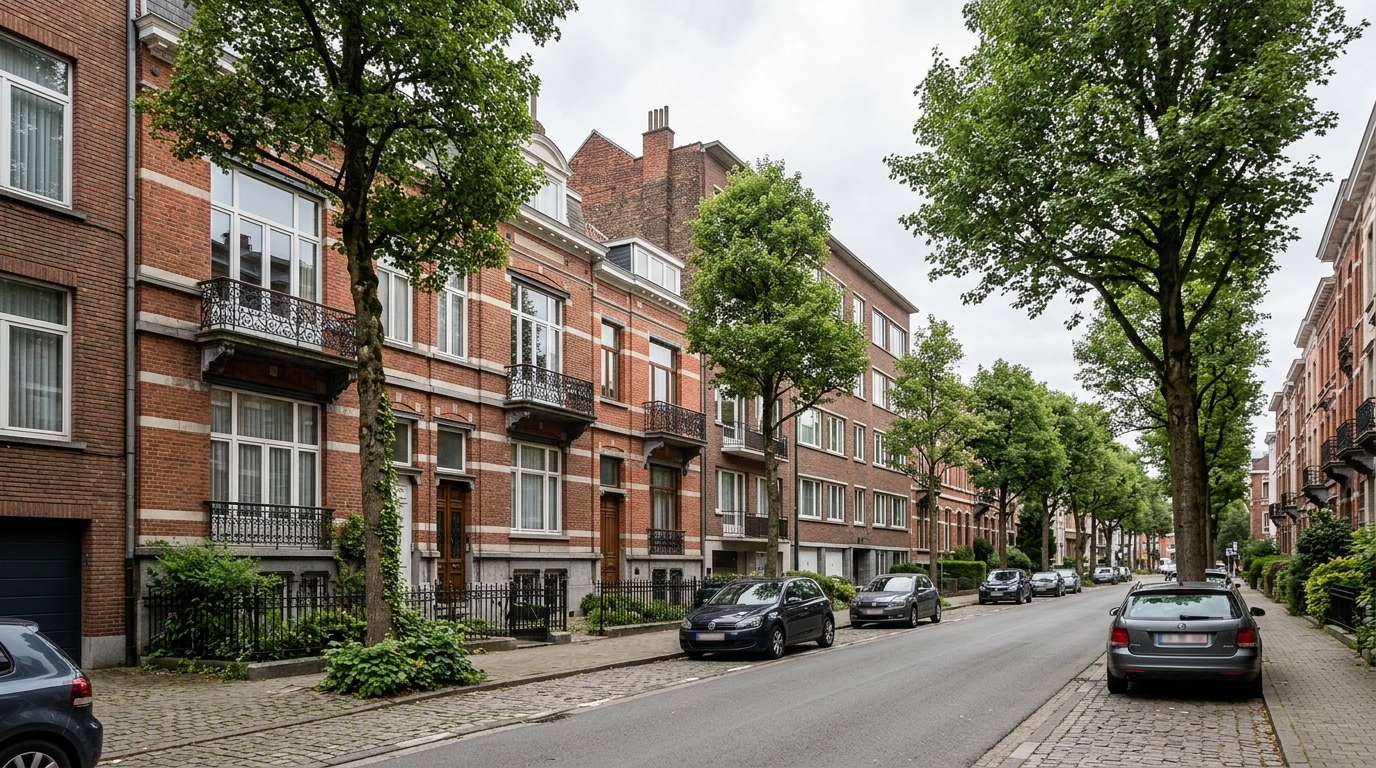
    The Stockel neighbourhood, located in the eastern part of Woluwe-Saint-Pierre, is an exception in the Brussels urban landscape. Its village atmosphere, tree-lined streets, Place Dumon and its quality shops give it a distinctive character that buyers seek out and sellers appreciate. Here is what our teams observe in this niche market.

    The neighbourhood at a glance

    Stockel is built around Place Dumon and its small shopping streets. The architecture is mixed: villas and detached houses from the 1920s to 1960s, apartments in well-maintained residences, and a few contemporary buildings. Green spaces are plentiful, with the Woluwe Park and the Foresterie estate nearby.

    Stockel metro station (line 1) provides direct access to central Brussels in around twenty minutes, which is a major asset for buyers who work in the city. The school offering is highly regarded both in the neighbourhood and in the municipality as a whole.

    The property market in the neighbourhood

    Stockel is one of the most expensive areas in Woluwe-Saint-Pierre. Upmarket villas and detached houses regularly sell for between €700,000 and €1,200,000, or even more for the most spacious and best-renovated properties. For apartments, prices generally range from €3,800 to €4,500/m² depending on the building and level of finish — above the municipal average reported by Statbel (€4,280/m² for houses, Q1–Q2 2026).

    The scarcity of available properties is a constant feature of this market. Selling mandates in Stockel remain few in number, which maintains upward pressure on prices and short selling times for well-positioned properties.

    Who is this neighbourhood for?

    Stockel mainly attracts affluent families, both Belgian and expatriate, seeking a high-quality living environment close to schools and shops. The presence of international and European schools less than ten minutes away plays a structuring role in demand.

    Sellers in Stockel are often long-standing owners who part with their property following an inheritance or a change in family circumstances. Intergenerational transfers are common in this neighbourhood, which contributes to the relative scarcity of properties on the market.

    Selling in this neighbourhood

    In such a selective market, the presentation of the property and the accuracy of the valuation are decisive. An overpriced property in Stockel does not find a buyer any faster than elsewhere: buyers viewing this type of property know the local market perfectly and will not make an offer beyond what they consider justified.

    The assets to highlight are the garden size, the living area, the condition of the roof and electrical installation, and the energy performance. Request a free valuation of your property in Woluwe-Saint-Pierre from our teams, who have known the specificities of Stockel for decades.

    Methodology and sources

    The price benchmarks cited are drawn from transactions tracked by Expertissimmo in Stockel during the first half of 2026, supplemented by Statbel data (Q1 and Q2 2026). All transactions are anonymised.

  • Neighbourhood focus: Helmet, the residential heart of northern Schaerbeek

    Neighbourhood focus: Helmet, the residential heart of northern Schaerbeek

    The Helmet neighbourhood occupies the north-western part of Schaerbeek, between the Chaussée de Haecht and the municipalities of Laeken and Evere. Less central than the heart of Schaerbeek, it offers in return a quieter living environment, tree-lined streets and a residential fabric dominated by single-family homes. It’s a neighbourhood our teams know well and one that attracts a specific buyer profile.

    The neighbourhood at a glance

    Helmet is a predominantly residential neighbourhood. Terraced houses from the 1930s to 1960s make up most of the built environment, with a few apartment buildings along the main roads. Place Helmet is the heart of the neighbourhood, with its weekly market and local shops.

    In terms of transport, the neighbourhood is served by several tram and bus lines (De Lijn and STIB), with access to the Brussels ring road just a few minutes away by car. The school offering is adequate, with several primary and secondary schools within walking distance.

    The property market in the neighbourhood

    Helmet stands out from the Schaerbeek average due to a high proportion of single-family houses, giving it a different market dynamic compared to the municipality’s more central neighbourhoods. As a benchmark, a three-façade house of 150 m² in good condition sells for between €350,000 and €420,000, slightly below the municipal average for this type of property, based on transactions tracked by our teams in the first half of 2026.

    Apartments are less common but sell quickly, particularly two-bedroom units in recent or renovated buildings with a lift.

    Who is this neighbourhood for?

    Helmet mainly attracts families seeking peace and space, often first-time buyers or those upgrading from an apartment. The affordability compared to neighbouring municipalities such as Laeken or Evere is an argument frequently mentioned during the viewings we organise there.

    Buy-to-let investors are also present, drawn by steady rental demand from families who cannot yet access homeownership but wish to remain in a residential setting.

    Selling in this neighbourhood

    If you’re selling a house in Helmet, the elements that make the difference are the garden (even a small one), the condition of the roof and electrical compliance. Buyers in this segment typically have prior property experience and can quickly assess the work required. A complete technical file speeds up the decision-making process.

    Good energy performance is an increasingly important selling point. An EPC certificate of class C or better can justify a price slightly above the neighbourhood average. Our teams can help you identify the most cost-effective improvements before putting your property on the market. Request a free valuation of your property in Schaerbeek to start your project on a solid footing.

    Methodology and sources

    The price benchmarks cited in this article are drawn from transactions tracked by Expertissimmo in the Helmet neighbourhood during the first half of 2026, supplemented by Statbel data (Q1 and Q2 2026). All transactions are anonymised.